

LEAN TRANSFORMATION & KANBAN
We help organizations define their value streams, streamline processes to remove waste, and align software applications and delivery programs to those value streams creating a single, end-to-end view of the cost spent delivering customer value and the benefit it realizes.
Steps in the lean improvement cycle
End-to-end view: cost spent to value delivered
Visual, pull-based delivery
Foundation of the ACE framework
THE PROBLEM WE SEE
Most organizations have a strategy. Far fewer have a reliable way to translate that strategy into the day-to-day work of every team and system that touches the customer.
Leadership sets direction, but without a mapped value stream there is no fast, repeatable path from strategy to operational delivery.
When teams aren't aligned to a shared value stream, handoffs create ambiguity and ambiguity is where project delays begin.
Spend goes into programs and applications without a clear, end-to-end view of the customer value or benefit it produces.
Software investments are made system by system, rather than being aligned to the value streams they are meant to serve.
THE OUTCOME
Lean transformation isn’t a one-time exercise. It resets how strategy, teams, and technology stay connected on an ongoing basis.
A single view that connects the cost spent delivering customer value to the actual benefit realized visible to both leadership and delivery teams.
Mapping strategy directly to value streams is the quickest route from a new idea to operational delivery so innovative strategies don't stall in translation.
When every team is organized around the same value stream, handoffs are clearer, ownership is clearer, and communication-driven delays fall away.
Once strategy, teams, and systems share one map, the organization can respond to change quickly without re-architecting how it works each time.
OUR METHOD
A continuous, four-step cycle not a one-time project. Each pass removes more waste and sharpens the alignment between value and delivery.
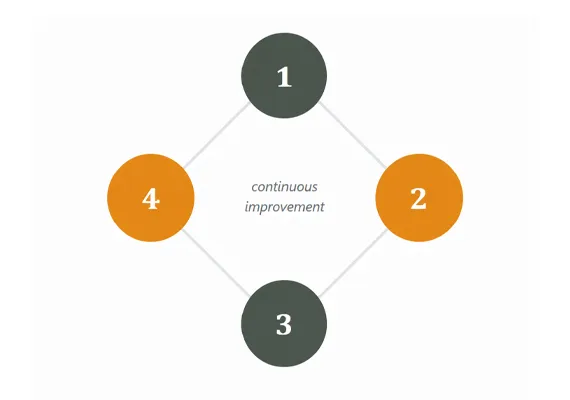
Define what the customer actually values the outcome the organization is chosen for.
Map every step, team, and system involved in delivering that value, end to end, as it happens today.
Identify delays, rework, and hand-off friction that consume cost without adding customer value then remove them.
Treat the value stream as never finished. Continuously refine it as needs, technology, and markets shift.
MAKING FLOW VISIBLE
A value stream is only manageable once it’s visible. Kanban boards make the flow of work through each stage explicit so bottlenecks and waste show up immediately.
New feature request
Change request
Data fix
API integration
Report build
UAT sign-off
Dashboard release
Process update
An illustrative board each column is a stage of the value stream; work-in-progress limits keep the flow honest instead of overloaded.
Teams pull the next item when they have capacity, rather than work being pushed onto already-overloaded stages.
Capping work-in-progress at each stage makes overload visible immediately, instead of hiding it in someone’s queue.
The same board gives leadership a real-time view of flow and gives delivery teams a shared, unambiguous source of truth.
A WORKED EXAMPLE
A value stream maps business operations stage by stage and against each stage, the software systems that support it. This is a generic illustration, not client-specific data.
Website / CRM
ERP / Inventory
Internal ERP
Order Tracking
CRM
Business operations on top, the underlying software system for each stage below a single map both business and technical stakeholders can read.
Mapping strategy directly to value streams like the one above is the fastest way to turn a new strategic direction into operational reality, because every team and system in the chain already knows where it sits.
THE CAPABILITY THIS UNLOCKS
The ability of a business to respond to changing technology, market, and competitive landscapes overcoming threats and pursuing new opportunities by quickly forming new strategies and implementing them in a flexible, coordinated way.
Markets, technology, and customer expectations shift faster than annual planning cycles can absorb.
Leaders face challenges without a clear precedent or a reliable playbook to follow.
Solutions increasingly span multiple teams, systems, and dependencies rather than a single fix.
The right path forward is rarely obvious, and leadership must decide with incomplete information.
Business agility, built on a lean, value-stream-driven foundation, is how organizations navigate this warding off threats and pursuing new opportunities instead of being caught flat-footed by them.
THE OPERATING MODEL
Business agility isn’t a department it’s a chain that connects leadership’s strategy all the way down to the teams and systems delivering it, with the value stream as the throughline.
CxO and top leadership set direction in response to market and competitive change
Strategy is translated into value streams and portfolio requirements
Mid-management coordinates program features across the value stream
Agile programs and MVPs delivered by teams working against the systems below
Marketing Website
Core Banking / ERP
Logistics & Procurement
CRM
Digital Channels
LOOKING AHEAD
Meeting the letter of the Act is straightforward to state and difficult to execute. Four challenges recur across every DPDP compliance program:
Organizations that pursue AI transformation without a lean, value-stream-driven foundation tend to bolt AI onto disconnected processes and systems. Business agility built through lean transformation is the prerequisite, not an afterthought.
That’s why it’s the first pillar of our Value Stream Driven Tactical AI Transformation Framework. Once value streams, waste reduction, and team alignment are in place, extending into AI-led business transformation becomes a natural next step rather than a disconnected initiative.
Let’s identify where value is created in your organization, where waste is hiding, and how to align your teams, applications, and programs to deliver it consistently and visibly.