

AI READINESS ASSESSMENT
A diagnostic assessment ahead of AI-led transformation
OVERVIEW
Foundational LLMs and AI tools are now within reach of every employee, and most organisations are already using them for individual productivity gains. Moving from that stage to a tactical or strategic AI capability depends on the maturity of the organisation’s processes, data, innovation practice, and delivery capability. This assessment establishes where an organisation stands today, and what is required to progress.
of AI pilots reported to stall before reaching scale, across multiple industry surveys
of AI adoption assessed Operational, Tactical, Strategic
of transformation foundation measured before a roadmap is recommended
WHY MOST AI INITIATIVES STALL
The rapid proliferation of AI technology across sectors has made foundational LLMs and AI tools available to any employee. Most organisations are already at this stage of adoption using these tools individually, for search, drafting, summarising and advice, and realising genuine productivity gains at the individual level.
Difficulty tends to appear once an organisation tries to move beyond this. The pattern behind it is usually a technology-first approach: identifying every place AI could conceivably be applied, without first establishing whether that is the right application, and without checking whether the organisation has the foundation to carry it through to scale.
of AI initiatives do not progress beyond the pilot stage, per industry survey reports.
ASSESING THE APPROACH: TWO WAYS TO APPROACH AI ADOPTION
The difference in approach is what separates a pilot that stalls from one that scales.
ASSESSING THE READINESS FOR THREE LEVELS OF AI ADOPTION
AI adoption typically progresses through three levels, each requiring a greater degree of foundation than the one before it.
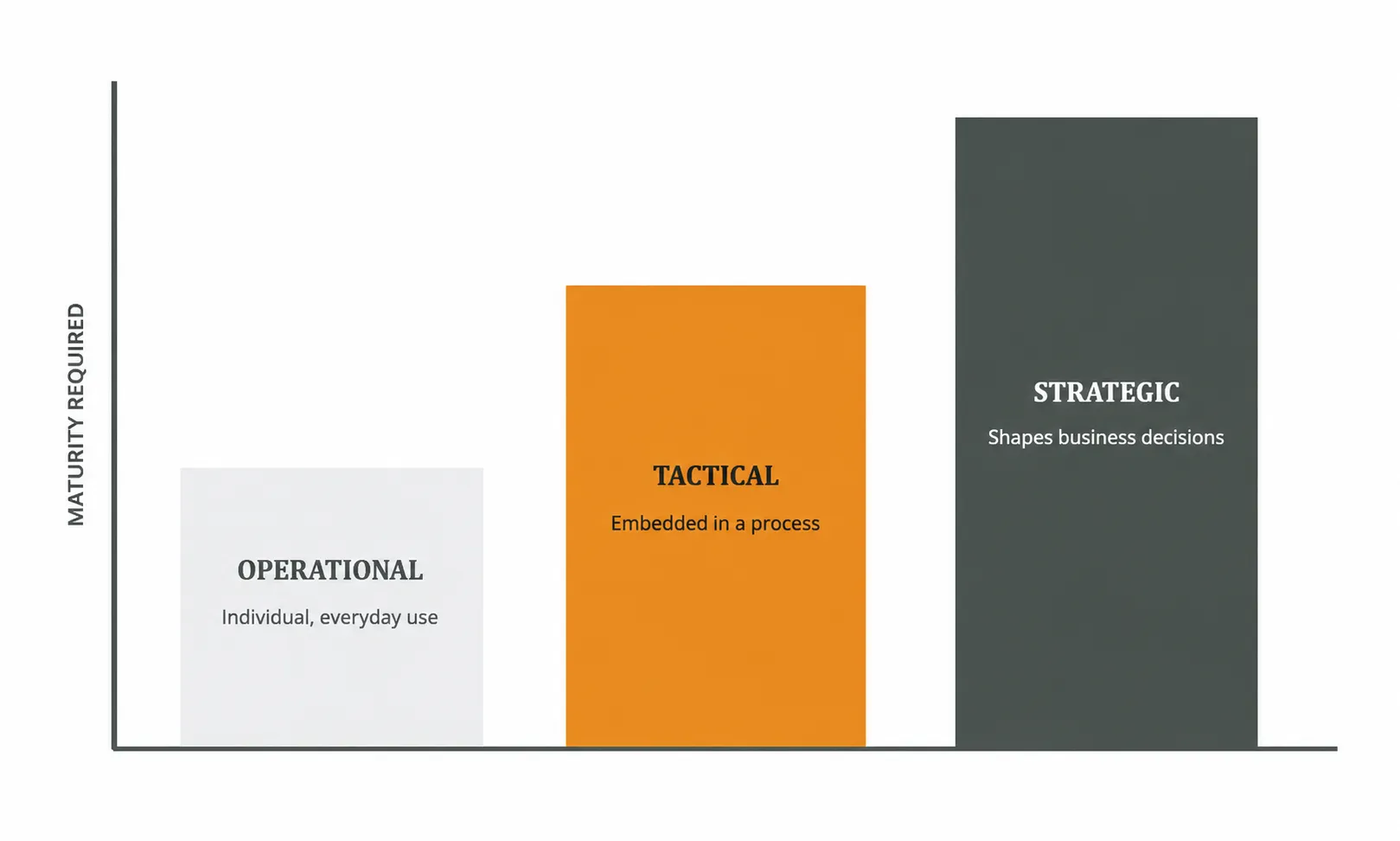
The dashed line marks the ceiling most organisations reach with individual, operational use — the point at which, per industry surveys, more than half of AI initiatives do not progress further.
WHAT EACH LEVEL MEANS
LEVEL 1 — OPERATIONAL
Employees use AI tools such as LLM assistants on an individual basis for search, drafting, and advice. The gains are real but limited to the individual and not embedded into any process.
LEVEL 2 — TACTICAL
AI is applied to a defined task within a process data analysis, content generation, risk assessment, or agentic automation of a specific workflow step producing a measurable, process-level benefit.
LEVEL 3 — STRATEGIC
AI becomes part of how the organisation competes influencing products, business models and enterprise-wide decisions built on a mature process, data and delivery foundation.
WHAT TACTICAL AND STRATEGIC ADOPTION REQUIRES
Applying AI at the tactical and strategic level is not primarily a technology decision. It depends on the same foundation required for any digital transformation.
Standardised, well-understood processes with waste identified
Data that is available, connected, and of sufficient quality
A structured way to identify and prioritise the right problems for AI
Matching the right AI capability to the right problem, not the reverse
The delivery capability to pilot, measure, and scale in increments
These are the same five pillars assessed under the Value Stream Driven Tactical AI Transformation Framework (transformwithace.com/ai-led-business-transformation). The AI Readiness Assessment establishes where an organisation stands against each of them before transformation work begins.
ASSESSMENT SCOPE
The current state against each of the five pillars, together with where AI usage currently sits across the three levels of adoption.
Where AI tools and initiatives are in use today, by whom, and at what level.
How standardised the target processes are, and where waste and variability remain.
Whether the data an AI use case needs is available, connected, and of sufficient quality.
How the organisation identifies and prioritises problems worth solving with AI.
Whether the AI capability under consideration is genuinely matched to the problem.
Whether the organisation can pilot, measure, and scale an AI initiative in increments.
HOW THE ASSESSMENT IS CONDUCTED
Structured to produce an evidence-based view of current maturity and a practical path forward.
Structured interviews and document review across the target value stream
Current state scored against each of the five pillars and the three adoption levels
Gaps identified between current state and what tactical or strategic adoption requires
A prioritised, sequenced roadmap to close the gaps and realise AI benefit
WHAT YOU RECEIVE
The assessment concludes with a set of concrete outputs.
Current level of AI adoption Operational, Tactical, or Strategic scored against each of the five pillars.
Specific gaps between current state and the foundation required for the next level of adoption.
A sequenced set of initiatives to close the identified gaps, ordered by dependency and effort.
Defined, measurable benefits expected at each stage of the roadmap, with a baseline for comparison.
NEXT STEP
Organisations considering AI investment beyond individual tool use can use this assessment to establish their current position and a realistic path to the next level of adoption, before committing to a larger transformation programme.