

Transformation Services
A structured path that takes a business from its current state to an AI-enabled operating model built on digital transformation, business agility, and a value-stream-driven tactical framework for AI adoption.
The Foundation
Before an organization can adopt AI at scale, it needs the underlying capability that lets it change quickly and reliably. That capability is business agility, and it is built through digital transformation.
Re-architects how the business operates processes, data, and systems as the base layer of change.
The capability this produces: the organization can sense change and respond to it quickly.
AI is layered onto this agile foundation, applied where it creates the most business value.
Business Agility — Defined
The ability of a business to respond to changing technology, market, and competitive landscape to overcome threats and pursue new opportunities by quickly formulating new strategies and implementing them in a flexible manner.
The Method
A value stream is the end-to-end sequence of activities that delivers value to a customer from request to fulfilment. Strategy is only realized when it is translated into these operational value streams; mapping strategy to value streams is the fastest route from intent to execution. The transformation follows the classic lean sequence:
Define value from the customer's point of view.
Map every step, system, and handoff that produces it.
Remove delays, rework, and non-value-adding steps.
Continuously refine the stream as conditions change.
The Framework
A five-part operating model that plugs AI into a business’s value streams, one MVP at a time.
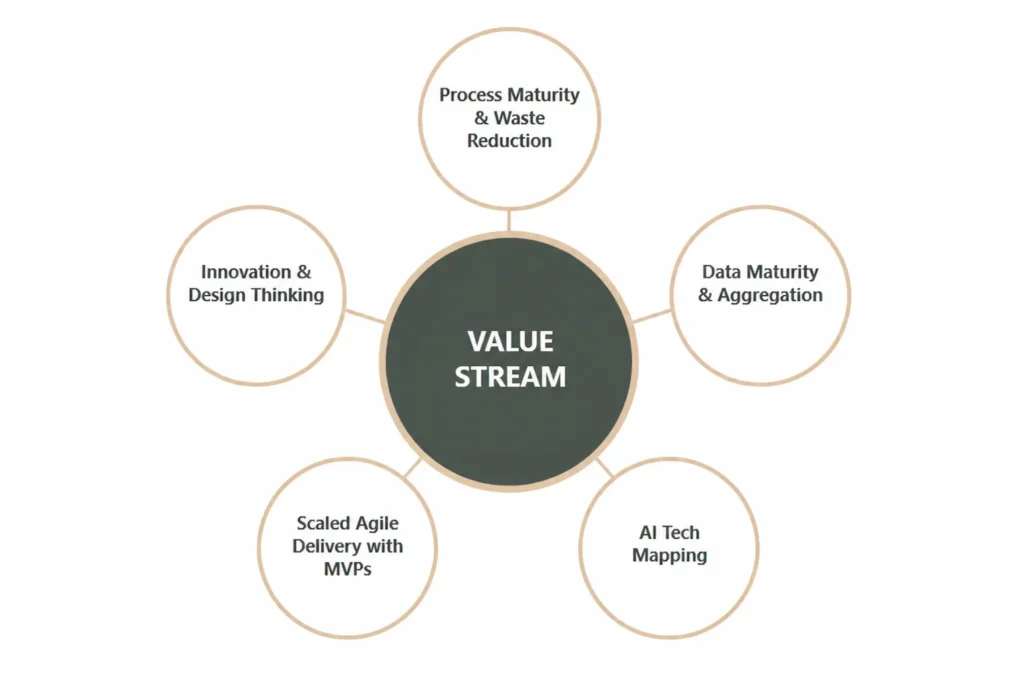
The Value Stream Driven Tactical AI Transformation Framework five capabilities applied around the value stream at the center of the transformation.
Process maturity assessment and waste reduction across the end-to-end stream.
Establishing what data exists, its quality, and how it is brought together at each stage.
Surfacing the real problems worth solving at each stage of the value stream.
Matching each identified problem to the right AI/ML technique or tool.
Delivering the mapped solutions as prioritized, incremental MVPs.
How Each Stage Works
The current-state process is mapped stage by stage — every step, handoff, and system involved in delivering value to the customer. Delays, bottlenecks, and non-value-adding activity are identified at each stage before any technology is introduced.
For every stage of the value stream, the relevant data is identified: what exists, where it lives, and how complete or reliable it is. Data from disparate systems is aggregated so it can support a decision or a prediction at that stage.
Each stage is examined for the problems genuinely worth solving — where information flow can be converted into better decision flow, where waste can be designed out, and where a new capability would change the outcome.
Each problem identified is mapped to a specific AI or automation technique — for example, computer vision for counting or monitoring, machine learning for demand prediction, or deep learning for pattern detection — matched to the data and infrastructure available.
The mapped solutions are converted into a story map and sequenced into MVPs. The highest-value, lowest-effort capabilities are delivered first, with each MVP tied to a measurable benefit before the next increment is taken up.
Illustrative application
In one engagement, the framework was applied to a large-scale prasadam (temple offering) production and distribution system. The value stream order, kitchen preparation, warehouse movement, counter distribution was mapped stage by stage; relevant data (batch sizes, movement timings, counter stock, footfall) was identified at each stage; problems such as stock-out risk, ageing inventory, and unmanned counters were surfaced through design thinking; each was mapped to an AI technique (demand-prediction models, computer-vision-based footfall and queue counting); and the resulting capabilities were sequenced into MVPs starting with demand prediction and counter-stock dashboards, and extending to automated replenishment and pilferage alerts.
Service Output
The engagement produces a working set of artifacts and capabilities at each stage of the framework not just a strategy document.